
[VERIFY BEFORE PUBLISHING] Retired claims in this post
Migrated as published. It contains a guarantee, a 30-day promise, which the v3 copy removed in favour of "most firms are operational within weeks". Edit or retire this post before the site goes live. Remove this note when done.
Did you know that as of 1 July 2026, a single systemic failure in your anti-money laundering processes could trigger a maximum civil penalty of $36.4 million per breach? For many Australian SMEs, the scale of these AUSTRAC figures is enough to cause genuine anxiety. It’s understandable to feel drained by the administrative weight of manual KYC checks and the constant pressure to keep every file audit-ready. This guide will show you that the true cost of AML non-compliance Australia isn’t just about avoiding fines. It’s about reclaiming your team’s time and transforming these rigid obligations into a structured, billable professional service.
We’ll explore the latest 2026 penalty units, the operational drain of manual compliance, and the exact steps you can take to build a defensible program that satisfies the regulator while supporting your firm’s growth. By moving away from “tick-box” templates and choosing to organise your governance through automation, you can turn a perceived burden into a strategic advantage. Let’s look at how you can protect your practice and improve your bottom line at the same time, ensuring your compliance framework is as robust as it is profitable.
Key Takeaways
- Understand how the 1 July 2026 Tranche 2 expansion impacts your firm and which specific “designated services” now require mandatory AUSTRAC enrolment.
- Recognise the full cost of AML non-compliance Australia by calculating both the potential civil penalties and the hidden drain on your staff’s non-billable hours.
- Learn to quantify the administrative fatigue caused by manual identity checks and how automated workflows can significantly reduce your team’s workload.
- Discover practical methods to transform compliance from an overhead expense into a recoverable professional service that generates a clear return on investment.
- Establish an audit-ready program to ensure your documentation remains a robust safety net, protecting your practice against future regulatory scrutiny.
The 2026 Regulatory Landscape: AUSTRAC Tranche 2 and Your Firm
The date 1 July 2026 marked a fundamental shift in how professional services operate across the country. This wasn’t just a minor update to existing rules; it was the moment the “Tranche 2” reforms brought thousands of accountants, lawyers, and real estate professionals into the regulatory fold. The Australian Transaction Reports and Analysis Centre now views these professionals as essential gatekeepers in the fight against financial crime. While the transition may feel daunting, it’s helpful to view these requirements as a new standard for operational excellence. Moving from a reactive stance to a proactive compliance culture is no longer optional. With AUSTRAC now actively issuing Section 167 statutory notices to sample client files, “doing nothing” has become a high-risk strategy that could jeopardise the future of your practice.
Who is now a “Reporting Entity”?
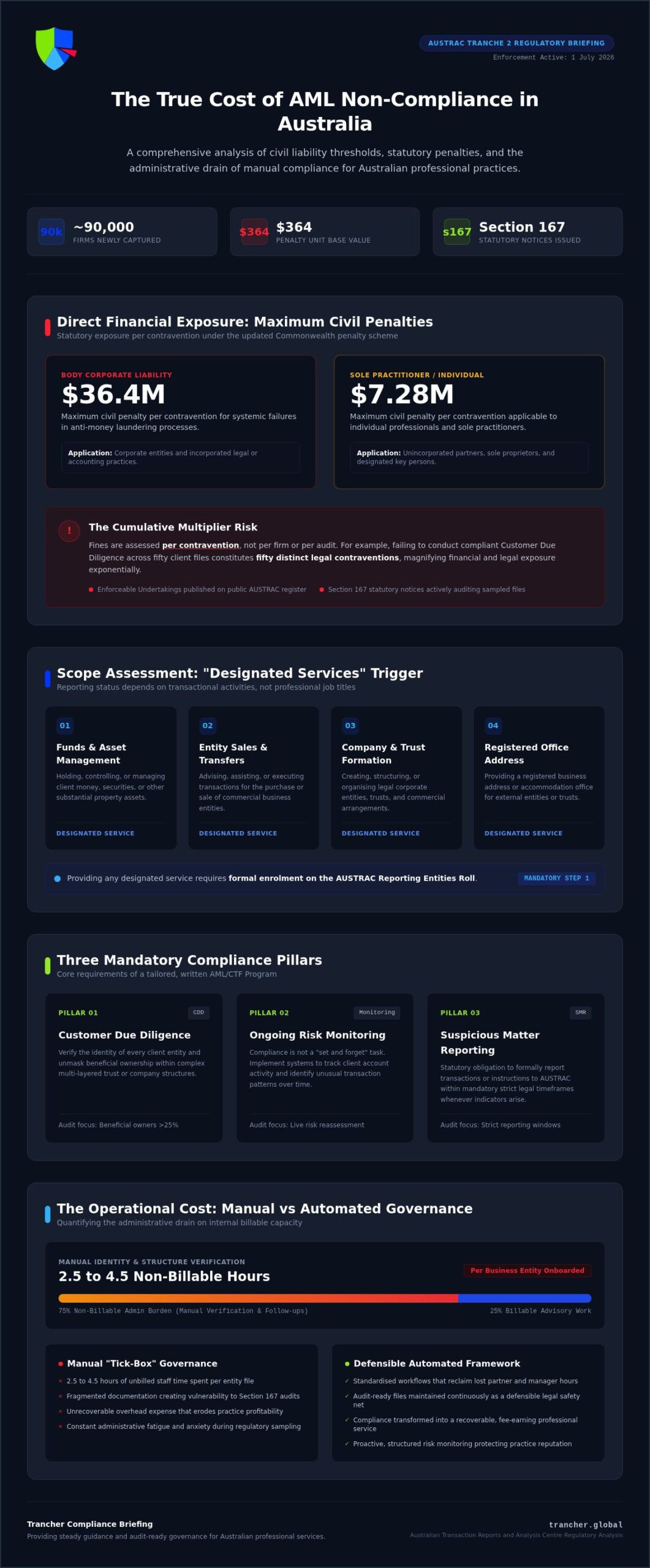
Determining if your firm is a reporting entity depends more on the services you provide than your professional title. Approximately 90,000 businesses are now captured by this mandate. You’re likely in scope if you perform “designated services,” which include managing client money or assets, assisting with the sale of business entities, or forming companies and trusts. Even providing a registered office address can trigger these obligations. If your firm provides these services, formal enrolment on the AUSTRAC Reporting Entities Roll is a mandatory first step. It’s a clear signal to the regulator that you’re aware of your duties and are acting in good faith to meet them.
The Core Obligations You Must Meet
Meeting your requirements involves more than just a one-off registration. You’re required to develop and maintain a written AML/CTF Program that’s tailored specifically to your firm’s unique risk profile. A generic template won’t suffice; the regulator expects to see a live document that reflects your actual clients and services. The cost of AML non-compliance Australia becomes painfully clear when firms fail to implement these core pillars:
- Customer Due Diligence (CDD): You must verify the identity of every client and understand the beneficial ownership of complex trust or corporate structures.
- Ongoing Risk Monitoring: Compliance isn’t a “set and forget” task. You need systems to track client activity and identify unusual patterns over time.
- Suspicious Matter Reporting (SMR): If a transaction feels “off,” you have a legal duty to report it to AUSTRAC within strict timeframes.
Implementing these steps manually can take between 2.5 to 4.5 non-billable hours per entity. However, by using structured automation, you can ensure your documentation is always audit-ready while significantly reducing the administrative burden on your staff. This proactive approach protects your firm from the cost of AML non-compliance Australia and ensures you remain a trusted partner to your clients.
The Direct Financial Impact: AUSTRAC Penalties and Enforcement
Understanding the financial ramifications of a regulatory breach is essential for any SME. As of 1 July 2026, the Commonwealth penalty unit value stands at $364. This means a body corporate faces a maximum civil penalty of $36.4 million per contravention. For individuals or sole practitioners, the risk reaches up to $7.28 million. It’s vital to remember that these fines are often calculated per breach. If you fail to conduct proper due diligence on fifty clients, you aren’t looking at one fine; you’re looking at fifty distinct legal issues. This cumulative effect is the most significant factor in the total cost of AML non-compliance Australia.
Beyond the headline fines, AUSTRAC uses several mechanisms to ensure firms correct their course. You might face an Enforceable Undertaking (EU), which is a public commitment to overhaul your systems under strict supervision. These are not private matters; they are published on the regulator’s website, creating a “reputational tax” that can alienate high-value clients and professional partners. For a detailed breakdown of these legal ramifications, you can review the AUSTRAC guidance on consequences of non-compliance. Taking early action to secure your practice is always the more prudent financial decision.
Civil vs. Criminal Penalties
Most enforcement focuses on civil penalties for systemic failures or negligence. However, if a firm willfully facilitates money laundering or engages in “tipping off”, where a client is alerted to a suspicious matter report, the matter can escalate to criminal investigation. In these cases, the AML/CTF Compliance Officer may face personal liability, including potential imprisonment for up to two years. Maintaining clear, audit-ready records is your best defence against claims of negligence or misconduct. If you’re looking to simplify your path to readiness, you can explore how automated program management removes the friction from your daily workflow.
The Cost of Mandatory Remediation
If your firm is found to have deficiencies, the financial drain extends far beyond the fine itself. You’ll often be forced to pay for an independent AML audit, which for small-to-medium practices can range from $100,000 to over $350,000 in external fees and lost billable time. Remedying a broken framework while under the regulator’s clock is stressful and inefficient. Proactive management is always the more cost-effective choice. To help your team stay ahead of these requirements, we’ve developed The Compliance Officer Toolkit, which provides the resources needed to manage these obligations confidently and avoid the cost of AML non-compliance Australia.
Beyond the Fines: The Hidden Operational Costs of Manual Compliance
While the threat of multi-million dollar fines captures headlines, the day-to-day cost of AML non-compliance Australia often manifests as a slow drain on your firm’s most valuable resources. Managing compliance manually isn’t just a regulatory risk; it’s an operational bottleneck. For many SMEs, the administrative burden averages between 2.5 to 4.5 non-billable hours per entity. When you multiply this across your client base, the lost billable time is staggering. This “hidden tax” on your productivity can quietly erode your profit margins long before a regulator ever knocks on your door.
There is also a human cost to consider. Your staff joined the profession to solve complex problems and support clients, not to act as unpaid investigators. Forcing skilled team members into “policing” roles through manual KYC and beneficial ownership checks can lead to significant burnout and morale issues. This friction often bleeds into client relationships. If your onboarding feels like a clunky interrogation rather than a welcoming, professional process, you risk alienating the very people you aim to serve. High-value clients expect efficiency, and manual processes fail to deliver it.
Poorly managed investigations also carry the risk of “tipping off” offences. Under Section 123 of the Act, accidentally alerting a client that they are under scrutiny can lead to criminal charges. Without a structured system to manage sensitive information, your team is left exposed to mistakes that carry severe personal consequences. Protecting your staff from these risks is just as important as protecting your firm’s bank account.
The Spreadsheet Trap
Relying on spreadsheets to manage AML obligations is a common pitfall for Australian firms. While they seem convenient at first, manual record-keeping rarely passes the “audit-ready” test during an AUSTRAC review. Spreadsheets lack the version control, secure audit trails, and automated reminders necessary to maintain consistency across a growing firm. To ensure your practice stays protected, it’s essential to move toward Audit-Ready Compliance Records that provide a clear, defensible history of your due diligence efforts without the manual headache.
Client Onboarding Friction
In a competitive market, speed and ease of use are major brand differentiators. Slow, paper-based KYC processes drive potential clients toward competitors who offer a seamless digital experience. This friction isn’t just an inconvenience; it represents a direct loss of revenue and opportunity. The latest FATF evaluation and standards for Australia highlighted the need for more robust controls in non-financial sectors, but these controls shouldn’t come at the expense of your client experience. By automating verification, you protect your brand and ensure that compliance supports your firm’s growth rather than hindering it.
Manual vs. Automated: A Cost-Benefit Analysis for SMEs
Deciding between manual processes and automated systems often comes down to a choice between visible and invisible costs. While a software subscription appears as a line item on your monthly budget, the ongoing cost of manual labour is a silent profit killer. When senior partners or compliance officers spend hours cross-referencing spreadsheets and verifying identity documents, the opportunity cost is significant. By automating these workflows, you don’t just avoid the cost of AML non-compliance Australia; you reclaim time that can be directed toward high-value advisory work.
Human error is a constant risk in manual PEP (Politically Exposed Person) and Sanction screening. It’s incredibly easy to miss a name variation or an outdated list when your team is managing multiple client files under pressure. Automated platforms provide “perpetual KYC”, which means your client base is monitored continuously rather than just during the initial onboarding. This ongoing vigilance ensures you remain compliant as client circumstances change, providing a level of security that manual checks simply cannot match. With a 30-day compliance-ready guarantee, the transition from manual uncertainty to automated confidence is both swift and secure.
Calculating Your Compliance ROI
To truly understand the value of automation, you must measure the time saved per client onboarded. If manual verification takes upwards of four hours per entity, reducing that to minutes creates a clear financial return. Centralising your documentation into a single, audit-ready source of truth also eliminates the frantic search for records during a regulatory review. You can use Compliance ROI Tracking Software to quantify these efficiencies and demonstrate exactly how your compliance efforts are contributing to the firm’s bottom line. This shift helps you view the cost of AML non-compliance Australia as a preventable expense rather than an inevitable burden.
The Security of Expert Support
Technology is only one part of the solution. For Australian SMEs, the value of local onboarding and expert support cannot be overstated. Global self-serve platforms often lack the nuanced understanding of the local regulatory environment that a dedicated partner provides. Having a compliance specialist on-call reduces the “anxiety cost” for firm partners, ensuring that complex questions are answered by someone who understands your specific business context. This supportive approach turns a regulatory hurdle into a manageable part of your operations. If you’re ready to secure your practice, you can get started with a platform built for Australian professionals today.
Transforming Compliance into a Profitable Service Capability
Viewing regulatory requirements as a sunk cost is a missed opportunity for growth. While many firms focus solely on the potential cost of AML non-compliance Australia, progressive practices are reframing these obligations as a high-value professional service. Just as clients expect to pay for tax compliance or audit services, they understand the value of identity security and financial integrity. By communicating the rigorous nature of these checks, you position your firm as a premium partner that prioritises safety and regulatory excellence. This shift in mindset turns a mandatory chore into a sophisticated advisory capability.
Modern compliance tools allow you to identify new revenue streams through structured risk assessments. When you perform a deep dive into a client’s corporate structure or source of wealth, you’re providing a level of due diligence that has genuine commercial value. These insights often lead to broader advisory conversations about asset protection and corporate governance. Instead of absorbing the workload, you’re expanding your service menu with high-demand, high-value activity that protects both your firm and your clients’ interests.
Making Compliance a Recoverable Activity
To justify compliance fees, transparency is essential. Using evidence-based tracking allows you to demonstrate the specific work performed, from beneficial ownership mapping to complex sanctions screening. This data provides a clear foundation for a recovery fee or a structured compliance service item on your invoices. When you show clients the depth of the risk assessment performed, you build trust rather than losing it. For a deeper look at managing these expenses effectively, see our guide on AML CTF Compliance Costs Reduction. Most clients will respect the investment you’ve made to keep their financial dealings secure and audit-ready.
The Trancher Advantage
Our platform is purpose-built to make this transition seamless for Australian SMEs. We provide a 30-day compliance-ready guarantee to ensure your practice meets all Tranche 2 requirements without delay. To help you test the profitability of these services in real-time, we offer a 3-month complimentary trial. At the end of this period, you’ll receive a formal ROI report and billable activity summary. This report quantifies the time saved and identifies recoverable costs, giving you a clear commercial roadmap. It’s an assured way to protect your practice from the cost of AML non-compliance Australia while simultaneously building a more resilient, profitable business model.
Securing Your Firm’s Future with Confidence
The transition to the Tranche 2 regime doesn’t have to be a source of stress or administrative fatigue. By moving away from manual spreadsheets and adopting a structured, automated framework, you protect your practice from the significant cost of AML non-compliance Australia. We’ve explored how you can reclaim valuable billable hours and reposition mandatory identity checks as a premium professional service. This proactive approach ensures your documentation is always audit-ready while providing a seamless onboarding experience for your clients.
Our team is here to support you with dedicated Australian expert onboarding and a 30-day compliance-ready guarantee. Following your initial trial period, you’ll also benefit from a 20% discount for your first 12 months of subscription. Start your complimentary 3-month trial and turn compliance into a profit centre today. You’ve worked hard to build your practice; let’s ensure it remains resilient, compliant, and ready for growth in this new regulatory landscape. We’re ready to help you turn these obligations into a genuine strategic advantage.
Frequently Asked Questions
What is the maximum fine for AML non-compliance in Australia for 2026?
The maximum civil penalty for a body corporate in 2026 is $36.4 million per contravention. This is calculated using the Commonwealth penalty unit rate of $364 which took effect on 1 July 2026. For individuals or sole practitioners, the maximum fine reaches up to $7.28 million. Because AUSTRAC can assess penalties per breach, systemic failures across multiple client files can lead to cumulative fines that far exceed these individual figures.
Can AUSTRAC shut down my accounting firm for non-compliance?
Yes, AUSTRAC has the statutory power to suspend or cancel a firm’s registration if they fail to meet their regulatory duties. While the regulator often prefers remedial directions or enforceable undertakings to fix systemic issues, persistent or willful non-compliance can lead to the removal of your right to provide designated services. Losing your registration effectively stops you from performing common accounting tasks like forming companies or managing client money, which could lead to a total business closure.
How much does it cost to implement a compliant AML program?
The cost of implementation varies depending on whether you choose a manual or automated approach. Manual programs often incur high hidden costs through lost billable time, with staff spending between 2.5 to 4.5 hours per entity on identity verification. Automated platforms involve a subscription fee but significantly reduce labour expenses. Trancher offers a complimentary 3-month trial and a 20% discount on the first year, allowing firms to establish a compliant framework without an immediate upfront financial burden.
Is a manual spreadsheet-based AML program defensible in an audit?
Manual spreadsheets are increasingly difficult to defend in a formal AUSTRAC audit. While they might record data, they often lack the secure audit trails, version control, and automated screening logs required to prove consistent compliance. Regulators look for evidence of an active, operational program rather than static documents. Relying on spreadsheets increases the risk of human error and makes it challenging to demonstrate that you’ve conducted ongoing risk monitoring for every client.
What are the most common triggers for an AUSTRAC compliance review?
Approximately 70% of escalated enforcement actions are triggered by reporting and monitoring failures, such as missed Suspicious Matter Reports (SMRs). AUSTRAC also uses Section 167 statutory notices to sample client files from firms that have recently enrolled. Other triggers include tip-offs from financial institutions or inconsistencies in your annual compliance report. Proactive preparation is the most effective way to manage the cost of AML non-compliance Australia and ensure your records are always audit-ready.
How can I charge my clients for the cost of AML compliance?
You can charge clients by reframing AML obligations as a professional service rather than a hidden overhead. Many firms now include a specific compliance fee or incorporate identity verification into their onboarding service items. By using platforms like Trancher to track billable compliance activity, you generate the evidence needed to justify these costs to your clients. This transparency builds trust and allows you to transform mandatory regulatory work into a recoverable, profitable professional service.
What is the difference between a civil penalty and an enforceable undertaking?
A civil penalty is a court-imposed financial fine intended to punish and deter non-compliance. In contrast, an Enforceable Undertaking (EU) is a formal, public commitment made by a firm to remediate specific deficiencies under AUSTRAC’s supervision. While an EU avoids an immediate court-imposed fine, it often requires expensive independent audits and a total overhaul of internal systems. Both mechanisms are public and can significantly impact the long-term cost of AML non-compliance Australia for any SME firm.
Does Trancher offer a guarantee for AUSTRAC compliance?
Yes, Trancher provides a 30-day compliance-ready guarantee for Australian accounting firms. This ensures that your practice establishes a robust AML/CTF program, completes necessary client verification workflows, and meets AUSTRAC’s record-keeping requirements within a month of starting. The platform is designed to move your firm from administrative uncertainty to a state of operational readiness quickly. This guarantee is supported by dedicated Australian expert onboarding to help you navigate the specific Tranche 2 requirements commencing in 2026.