
[VERIFY BEFORE PUBLISHING] Retired claims in this post
Migrated as published. It contains a guarantee, a 30-day promise, which the v3 copy removed in favour of "most firms are operational within weeks". Edit or retire this post before the site goes live. Remove this note when done.
If you view your AML records as just another pile of administrative paperwork, you are missing the most significant revenue opportunity of the 2026 Tranche 2 reforms. With the 1 July 2026 commencement date fast approaching, many Australian firms feel a growing sense of regulatory pressure. You likely agree that managing manual spreadsheets and tracking inconsistent staff knowledge feels like a drain on your most valuable resource: time. While the fear of substantial AUSTRAC penalties for poor record-keeping is valid, compliance shouldn’t feel like a constant threat to your firm’s operational peace.
We’re here to show you that documenting AML training for staff can be a streamlined, automated process that protects your practice and creates a perfectly defensible audit trail. You’ll learn exactly how to build and maintain training records that satisfy regulatory requirements while turning compliance overhead into a clear, billable asset. This guide provides a methodical roadmap to transition from manual chaos to a sophisticated system that proves your value to clients and ensures you are ready for any audit long before the deadline arrives.
Key Takeaways
- Understand why AUSTRAC views undocumented training as non-existent and how to align your firm’s records with the specific requirements of the AML/CTF Rules.
- Master the process of documenting AML training for staff using a risk-based approach that ensures every team member’s education is audit-ready and defensible.
- Discover how moving from manual spreadsheets to automated repositories eliminates human error and simplifies the administrative burden ahead of the 1 July 2026 deadline.
- Explore how detailed training logs can justify compliance fees on client invoices, transforming a regulatory requirement into a transparent, billable professional service.
- Identify how to categorise role-based training needs to create a structured record-keeping system that demonstrates proactive compliance and high-level oversight.
Why Documenting AML Training for Staff is a Strategic Priority in 2026
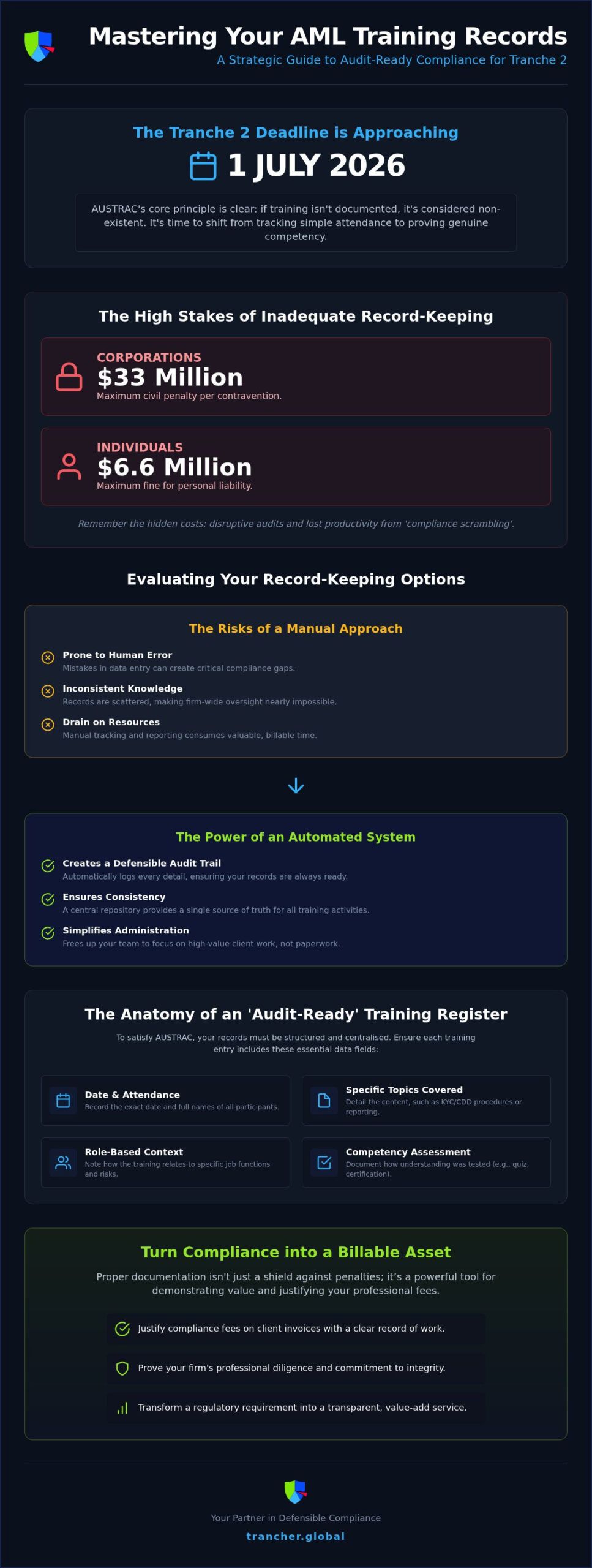
The commencement of Tranche 2 obligations on 1 July 2026 marks a fundamental change for Australian professional services. It’s no longer enough to simply “do” compliance; you must be able to prove it with granular detail. This shift aligns Australia with the international framework of anti-money laundering standards, moving our local industry toward a model of defensible accountability. For partners and directors, documenting AML training for staff is the primary shield against personal liability. It transforms a vague internal process into a verified record of professional diligence and operational health.
AUSTRAC operates on a straightforward principle: if a training session isn’t recorded in your register, it effectively never occurred. This isn’t just about avoiding a “tick-box” exercise. It’s about establishing a system of internal quality control. When you maintain precise records, you ensure that every team member understands their specific role in mitigating financial crime. Reframing your documentation as a strategic asset allows you to maintain consistency across the firm, ensuring that knowledge doesn’t walk out the door when a staff member leaves.
Moving Beyond the Annual Seminar
The days of the generic, once-a-year compliance seminar are over. In a dynamic risk environment, AUSTRAC expects training that’s tailored to specific roles and emerging threats. 2026 regulations focus on “competency” rather than just “attendance.” This means your records should show not just who sat in a room, but how they demonstrated their understanding of your firm’s specific AML/CTF Program. Role-specific training ensures that your frontline staff know how to spot red flags, while your management team understands their reporting obligations. It’s a move toward a living, breathing culture of compliance.
The Cost of Inadequate Record-Keeping
The financial stakes are exceptionally high. Corporations face maximum civil penalties of $33 million per contravention, while individuals can be fined up to $6.6 million. Beyond these headline figures, the hidden cost of “compliance scrambling” during an audit can derail your firm’s productivity for weeks. Poor records also undermine your ability to transparently bill clients for compliance services. Accurate records of documenting AML training for staff provide the evidence needed to justify these fees as a professional value-add. It turns a regulatory burden into a clear demonstration of your firm’s expertise and commitment to integrity. If you are new to these obligations, our guide on Tranche 2 explained for dummies provides a clear overview of exactly what your firm needs to understand before the deadline arrives.
AUSTRAC Standards: What Makes a Training Record ‘Audit-Ready’?
AUSTRAC’s expectations for record-keeping are precise and non-negotiable. To satisfy an auditor, your training register must demonstrate that your staff haven’t just attended a session, but have actually internalised the specific risks relevant to your firm’s operations. We define ‘audit-ready’ as a state where records are structured, centralised, and immediately retrievable. Under Part 8.2 and 9.2 of the AML/CTF Rules, your documentation must prove that your training programme is both ongoing and tailored to the unique risk profile of your practice.
When documenting AML training for staff, you must ensure the logs are directly linked to your formal AML/CTF Programme. This ensures that if AUSTRAC ever requests an inspection, you can show a clear line of sight between the risks you identified and the education your team received. Adopting a risk-based approach means your records should reflect deeper training for high-risk roles, such as those handling large cash transactions or managing foreign PEPs. If you are looking to simplify this process, our integrated record-keeping modules can help automate these data entries.
The Essential Data Fields for Your Training Register
A compliant training register requires more than a simple sign-in sheet. To meet the standard of being audit-ready, each entry should capture specific data points that prove the depth of the education provided. Your register needs to be a granular history of your firm’s commitment to compliance. Ensure your system captures the following fields for every session:
- Date and Attendance: The exact date the training occurred and the full names of all participants.
- Specific Topics: Detail exactly what was covered, such as KYC/CDD procedures, SMR triggers, or PEP screening protocols.
- Method of Delivery: Note whether the training was an online module, an internal workshop, or a briefing from an external expert.
- Proof of Competency: Include assessment scores or a signed declaration that the staff member understood the material.
Linking Training to the Business Risk Assessment
Your documentation must act as a mirror to your AML risk assessment tool Australia. It’s not enough to provide generic training; you must document that your team has been educated on the specific “red flags” identified in your firm’s risk assessment. As new money laundering typologies emerge, your training records should show a corresponding update in staff education. This proactive approach proves to AUSTRAC that your compliance culture is active rather than reactive. It demonstrates that you don’t just have a manual on a shelf, but a team that is consistently prepared for the evolving regulatory landscape.
Manual vs. Automated Record-Keeping: Evaluating Your Firm’s Options
Choosing between manual spreadsheets and automated systems is a decision that impacts your firm’s long-term scalability and regulatory safety. While a spreadsheet might seem like a low-cost starting point, it often becomes a form of “compliance debt” that grows more expensive over time. Documenting AML training for staff manually requires constant vigilance to ensure no certificates are lost and no refresher dates are missed. In a high-volume professional service environment, this administrative friction can lead to critical gaps in your audit trail that only become apparent when it’s too late.
Automated platforms reduce the risk of human error by centralising data and standardising entries. This is particularly vital for multi-office or remote teams where physical sign-in sheets are impractical. By moving to a digital system, you ensure that every record is secure and immediately retrievable from any location. This transition isn’t just about technology; it’s about shifting your firm’s focus from administrative survival to operational excellence. It allows your compliance officer to spend less time on data entry and more time on strategic risk management.
The Hidden Burden of Manual Tracking
Manual tracking relies on fragmented folders and human memory. You likely spend hours chasing staff for completion certificates or physical signatures. Generating a firm-wide compliance report at short notice becomes a stressful event rather than a simple administrative task. These manual logs often fail to support sophisticated billing or ROI tracking, making it difficult to justify the “compliance fee” on your client invoices. The labour cost of maintaining these manual systems often quietly exceeds the price of a dedicated platform, creating a hidden drain on your firm’s profitability.
Advantages of an Integrated Compliance Platform
An integrated platform transforms documentation from a reactive chore into a proactive asset. These systems provide automatic reminders for refresher training and legislative updates, ensuring your team remains compliant without manual oversight. You can generate audit ready compliance records instantly, providing peace of mind during internal reviews or AUSTRAC inquiries. This level of readiness is essential for meeting the 1 July 2026 deadline with confidence. When evaluating your options, consider the “Total Cost of Compliance” (TCC). This metric includes the software fee, the cost of staff hours spent on administration, and the potential risk of errors. Automated systems consistently offer a lower TCC by streamlining the process of documenting AML training for staff and providing a clear, defensible record for years to come.
Step-by-Step Guide to Establishing a Defensible Training Log
Creating a robust record-keeping system doesn’t have to be an overwhelming task. By following a structured workflow, you can move from a reactive posture to a proactive, audit-ready state. Documenting AML training for staff is most effective when it’s integrated into your firm’s daily operations rather than treated as a separate administrative burden. Here is how you can build a log that stands up to AUSTRAC scrutiny while supporting your firm’s growth.
- Step 1: Identify Role-Based Needs. Categorise your team into groups such as senior management, frontline staff, and compliance officers. Each group requires training tailored to their specific exposure to money laundering risks.
- Step 2: Centralise Your Repository. Select a secure, digital platform that’s accessible to your Compliance Officer. This eliminates the risk of missing certificates and ensures all data is in one reliable location.
- Step 3: Standardise Your Format. Use a consistent template for every entry. This ensures that whether the training was an internal briefing or an external webinar, the same essential data fields are captured every time.
- Step 4: Implement a Review Cycle. Set calendar reminders to review your training programme every six months. This ensures your content remains current with the evolving Tranche 2 landscape leading up to July 2026.
- Step 5: Link to Billing and ROI. Connect your training logs to your practice management or billing systems. This allows you to demonstrate the professional expertise behind your compliance fees and track the return on your investment.
If you want to simplify this entire workflow, our automated record-keeping modules can handle the heavy lifting for you, ensuring your logs are always audit-ready.
Defining Your Training Frequency
Your documentation should reflect a risk-based schedule rather than a generic annual calendar. New hires must receive induction training before they begin providing designated services. For existing staff, refresher training should occur at intervals determined by their role risk, typically every 12 months. It’s also vital to document trigger-based sessions. If there’s a change in legislation or you launch a new service line, record the ad-hoc briefings provided to your team to address these specific shifts.
Capturing Proof of Competency
AUSTRAC expects more than just a list of names. To build a truly defensible log, you must document that staff understood the material. Including results from short quizzes or assessment summaries provides tangible proof of competency. When documenting AML training for staff, store copies of external certificates directly alongside your internal logs. This creates a complete narrative that explains exactly why each staff member received their specific training and how it mitigates the risks identified in your firm’s assessment.
Turning Compliance Documentation into a Profitable Professional Service
Many firms treat the 1 July 2026 deadline as a looming hurdle. In reality, documenting AML training for staff serves as the ultimate proof of your firm’s professional standard. When you can present a client with a detailed record of the rigorous education your team undergoes, you transform an invisible administrative task into a visible value-add. This transparency justifies the “compliance fee” on your invoices, shifting the narrative from a cost of doing business to a premium service that protects the client’s interests. 2026 readiness is an opportunity to modernise your firm’s entire operational model.
Beyond simple record-keeping, the Trancher approach allows you to track compliance activity to identify new advisory streams. High volumes of complex KYC files or PEP screenings are often signals that a client requires more specialised, high-value advice. By meticulously documenting AML training for staff, you prove that your team possesses the specific expertise required to handle these sophisticated matters. It allows you to lead with confidence, knowing your internal systems are as robust as the advice you provide.
The ROI of Automated Record-Keeping
Manual tracking is a drain on your firm’s most valuable asset: billable time. When you calculate the hours saved on manual data entry and the stress avoided during audit preparation, the return on investment for automation becomes clear. Trancher’s ROI reporting turns compliance data into partner-level insights, showing exactly how efficiency gains contribute to the firm’s bottom line. To ensure your current framework is on the right track, compare your existing processes against our AML program checklist Australia. This baseline allows you to see exactly where automation can reclaim lost hours and improve your operational health.
Getting Started with Trancher
The transition to the new regime should be a period of growth, not a source of anxiety. We provide a complimentary 3-month trial for Australian accounting firms to help you experience the benefits of automated documentation firsthand. This trial includes our 30-day compliance-ready guarantee, ensuring your firm is positioned for success long before the Tranche 2 obligations commence. Early preparation is the key to a stress-free transition to the new regime. By starting now, you allow your team to acclimate to new workflows in a supportive environment, ensuring that by July 2026, your compliance programme is a well-oiled machine that supports your firm’s long-term profitability.
Securing Your Firm’s Future Beyond 2026
The transition to the Tranche 2 regime is a significant milestone for Australian professional services. By prioritising the process of documenting AML training for staff, you do more than just avoid penalties; you build a firm that is operationally resilient and transparent. Moving away from manual spreadsheets to an automated, centralised repository ensures your records are always audit-ready and defensible. It’s a shift that allows you to reclaim billable hours while providing clear evidence of the expertise you offer to your clients.
We are here to act as your expert companion during this transition. Trancher is designed specifically for Australian SME firms, providing local expert support from Aaron Soh and our dedicated team. We offer a 30-day compliance-ready guarantee to ensure you meet your obligations without the stress of administrative overhead. Start your complimentary 3-month Trancher trial today and get your firm Tranche 2 ready within 30 days. You have the opportunity to turn a regulatory requirement into a strategic advantage that supports your firm’s long-term growth and reputation. We look forward to guiding you toward a more streamlined and profitable future.
Frequently Asked Questions
What are the specific AUSTRAC requirements for documenting AML training?
AUSTRAC mandates that every reporting entity maintains a detailed training register as part of their AML/CTF Programme. Under Part 8.2 and 9.2 of the AML/CTF Rules, you must record the date of training, the names of all participants, and the specific topics covered. It’s also essential to document the method of delivery and proof that the staff member understood the material, such as assessment results or signed declarations.
How long do I need to keep records of staff AML training in Australia?
You are legally required to retain all AML/CTF related records, including your training logs, for a period of seven years. This timeframe ensures that you can provide a defensible audit trail if AUSTRAC conducts a retrospective review of your compliance history. Keeping these records secure and centralised is vital. Losing documentation from several years ago can lead to significant regulatory friction during an inspection or independent audit.
Can I use a simple spreadsheet to track my firm’s AML training?
While a spreadsheet is technically an option, it often creates a significant administrative burden and increases the risk of human error. Manual logs are difficult to manage consistently across a growing firm and rarely provide the automated reminders needed to ensure refresher training isn’t missed. Using a structured system for documenting AML training for staff is far more reliable, as it provides instant reporting and ensures your records remain audit-ready.
Does every staff member need the same level of AML training?
No, AUSTRAC expects a risk-based approach where training is tailored to a staff member’s specific duties and level of risk exposure. Frontline team members require deep knowledge of identifying “red flags,” while senior management needs a focus on governance and reporting obligations. Documenting these different levels of education proves to regulators that your firm understands its unique risk profile and has prepared its team accordingly for the 2026 commencement.
What happens if AUSTRAC audits us and our training records are incomplete?
Incomplete records are often viewed as a systemic failure of your AML/CTF Programme, which can lead to severe civil penalties. Corporations face fines up to $33 million per contravention, while individuals can be penalised up to $6.6 million. Beyond financial costs, AUSTRAC may issue enforceable undertakings or mandate independent audits. Having structured, retrievable documentation is your best defence against these outcomes, providing peace of mind that your firm is fully protected.
How often should I update my staff training documentation?
Your documentation should be updated every time a training event occurs, including initial inductions for new hires and annual refresher sessions. AUSTRAC suggests that refresher training for customer-facing staff should generally happen every 12 months, or more frequently if your firm’s risk profile changes. You should also record ad-hoc briefings that address new suspicious matter trends to demonstrate that your compliance culture remains proactive and current.
Is online AML training sufficient for AUSTRAC compliance?
Online training is a highly effective method for delivering compliance education, provided it is relevant to your firm’s specific AML/CTF Programme. To remain compliant, you must document that the online module covered your specific risks and included an assessment to prove staff competency. Simply clicking through slides isn’t enough. Your records must show that the training resulted in a genuine understanding of how to detect and report financial crime within your practice.
How can I make the process of documenting training less time-consuming?
The most efficient way to reduce the administrative load is to use an integrated compliance platform that automates record-keeping. By documenting AML training for staff through a digital system, you eliminate the need for manual data entry and physical filing. Platforms like Trancher offer automated reminders and instant audit-ready reports, allowing your team to focus on billable work while ensuring your firm reaches a compliance-ready status within our 30-day guarantee period.