
[VERIFY BEFORE PUBLISHING] Retired claims in this post
Migrated as published. It contains a guarantee, a 30-day promise, which the v3 copy removed in favour of "most firms are operational within weeks". Edit or retire this post before the site goes live. Remove this note when done.
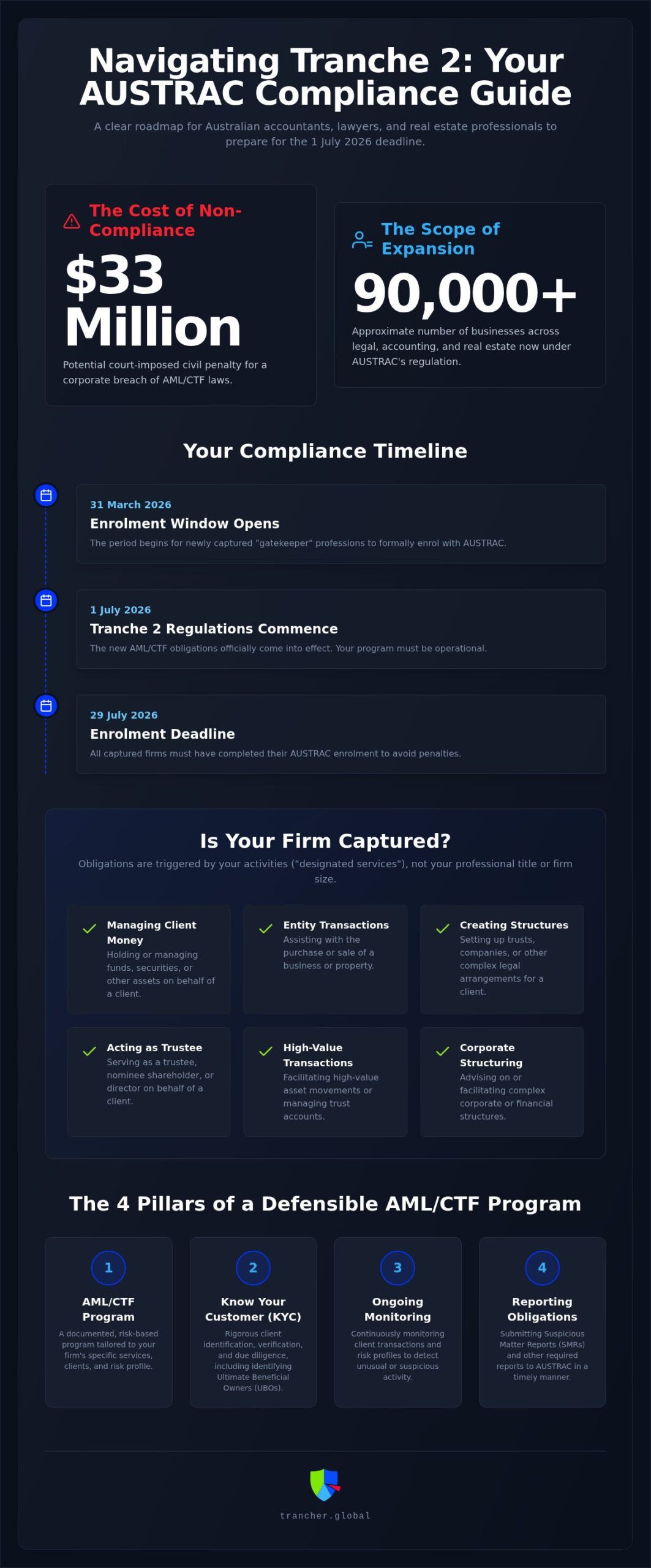
A $33 million penalty is a staggering price to pay for an administrative oversight, yet it represents the potential reality for Australian firms that fail to meet the new AUSTRAC standards. With approximately 90,000 businesses across the accounting, legal, and real estate sectors now in the regulatory spotlight, the pressure to adapt is undeniable. You’ve worked hard to build a reputation for excellence, and the last thing you need is a mountain of paperwork or the fear of a compliance breach hanging over your practice. This guide to Tranche 2 explained for dummies is here to help you cut through the noise and understand exactly what’s required before the 1 July 2026 deadline.
We realise that managing complex AML/CTF obligations can feel like a drain on your billable hours and a distraction from your core work. It doesn’t have to be a burden. This article provides a clear, actionable roadmap to secure your firm and automate your workflows. We’ll explore the essential steps for the 31 March 2026 enrolment window, the necessity of documented risk programs, and how to protect your practice while maintaining operational ease. By the end of this guide, you’ll have the confidence to turn these new obligations into a seamless, high-value part of your professional standard.
Key Takeaways
- Understand the significance of the 1 July 2026 deadline and why “gatekeeper” professions must complete their AUSTRAC enrolment by 29 July 2026.
- Use this guide to Tranche 2 explained for dummies to identify the specific designated services, such as managing client money or acting as a trustee, that capture your firm.
- Master the four pillars of a defensible AML/CTF program, moving beyond basic identity checks to implement comprehensive, risk-based client monitoring.
- Learn to frame compliance as a strategic advantage by utilising frameworks that transform administrative requirements into recoverable advisory value.
- Follow a structured 30-day readiness roadmap to appoint a Compliance Officer and establish an audit-ready program well before the regulatory commencement.
What is Tranche 2 and Why Does it Matter in 2026?
Tranche 2 represents the most significant expansion of Australia’s financial surveillance in decades. For years, only “Tranche 1” entities like banks and casinos had to worry about Anti-Money Laundering and Counter-Terrorism Financing (AML/CTF) laws. As of 1 July 2026, that changes. This guide to Tranche 2 explained for dummies clarifies how the net is widening to include “gatekeeper” professions. Accountants, lawyers, and real estate agents are now viewed as the front line of defence against financial crime.
The Australian government is closing a loophole that money launderers have long exploited. By moving money through professional services rather than banks, criminals could often bypass traditional security. AUSTRAC is now requiring approximately 90,000 Australian businesses to shift from a culture of informal trust to one of documented evidence. You’ll need to verify exactly who your clients are and where their funds come from, moving past simple handshakes to rigorous, audit-ready records. Providing Tranche 2 explained for dummies isn’t just about simplifying the law; it’s about ensuring you have the tools to stay compliant.
The Core Purpose of the AML/CTF Act
The Act exists to protect the integrity of the Australian economy from the ripple effects of financial crime and terrorism financing. It targets “designated services,” which are specific activities like managing client money, buying entities, or acting as a trustee. In the past, many firms relied on a “she’ll be right” approach to client background checks. Under the new regime, this informal strategy is a major risk. AUSTRAC requires a proactive, risk-based approach where you identify, mitigate, and manage the specific threats your firm faces every day.
The Consequences of Getting it Wrong
The stakes for non-compliance are high, but they’re entirely avoidable with the right systems. AUSTRAC can seek court-imposed civil penalties of up to $33 million for corporate breaches and $6.6 million for individual practitioners. Beyond the financial hit, the reputational damage of being “named and shamed” can be terminal for a professional firm. In cases of serious negligence or wilful blindness, the risk even extends to criminal investigations. Readiness isn’t just about avoiding fines; it’s about safeguarding your professional legacy and the trust you’ve built with your community.
Is Your Firm Captured? Identifying Designated Services
Many practitioners looking for Tranche 2 explained for dummies mistakenly believe that being a small firm or a sole trader grants them an exemption. It doesn’t. The focus shifts entirely from your professional title to the specific activities you perform for your clients. If you provide what AUSTRAC calls a “designated service,” your firm is captured under the Act. It’s a functional test rather than a categorical one, meaning your obligations are triggered by your actions rather than your accreditation.
For accountants, the triggers are often woven into everyday advisory work. Managing client funds, assisting with the purchase or sale of a business, or acting as a trustee all fall under the regulatory umbrella. Legal professionals and conveyancers face similar triggers when handling property transfers or setting up complex corporate structures. Real estate agents are included when they manage high-value transactions or operate trust accounts. If your work involves facilitating the movement of wealth or the creation of legal entities, you’re likely a “gatekeeper” in the eyes of the law.
Designated Services for Accountants
Specific activities carry higher regulatory weight and require immediate attention. Assisting a client with the acquisition of a new company or managing their securities isn’t just a service; it’s a designated service. Even setting up a trust structure or acting as a nominee shareholder for a client brings you into the fold. Industry leaders are already Preparing for Tranche 2 by auditing their service lists to see where these triggers exist. Understanding these nuances early allows you to integrate compliance into your existing workflows without disrupting your practice.
The “Gatekeeper” Responsibilities
AUSTRAC views these services as high-risk because they can be used to obscure the origins of illicit funds. As a gatekeeper, your primary responsibility is to “look through” the structures you create. This means identifying the Ultimate Beneficial Owner (UBO), the actual person who owns or controls the entity, rather than just the legal name on the paperwork. It’s a shift toward transparency that requires a structured approach to due diligence. For a deeper dive into the practicalities of this process, you can explore our CDD and KYC Requirements Australia: The 2026 Accountant’s Guide. Mastering these responsibilities ensures you’re not just checking boxes but actively protecting your firm’s integrity and long-term viability.
The 4 Pillars of a Defensible AML Program
Building a compliance framework might sound daunting, but it’s really about four foundational pillars. When you look at Tranche 2 explained for dummies, these pillars simplify the complexity into manageable steps that protect your practice. A defensible program isn’t just about avoiding fines; it’s about creating a reliable system that proves you’ve taken reasonable steps to mitigate risk. By focusing on these core areas, you can turn a regulatory requirement into a standard part of your professional excellence.
KYC and Customer Due Diligence (CDD)
Identity verification has evolved far beyond a simple driver’s licence check. Under the new rules, you’re required to understand the “source of wealth” for your clients. If a new client suddenly possesses significant funds for a business acquisition, your role is to verify the legitimacy of those assets. You’ll also need to screen for Politically Exposed Persons (PEPs) and check international sanctions lists. It’s a thorough process, but it doesn’t have to be confrontational. We find that most clients appreciate the professionalism of these checks when you explain they’re now a standard industry requirement, similar to what they’d experience at a bank. This approach maintains the relationship while ensuring your firm stays fully compliant.
The Business Risk Assessment
This is your firm’s defensive shield. A written assessment allows you to document the specific risks inherent in your unique client base and service offerings. For example, a firm specialising in international trade faces different challenges than one focused on local retail. Using a dedicated AML risk assessment tool Australia ensures your methodology is consistent and your templates are always ready for review. Staying “audit-ready” means you don’t have to scramble when AUSTRAC requests information. Your reasoning, controls, and risk-mitigation strategies are already recorded and accessible, giving you peace of mind and operational confidence.
Ongoing monitoring ensures your compliance remains current. It’s not a “once-and-done” checkbox; it’s a commitment to noticing if a client’s behaviour or risk profile changes over time. Finally, you have a reporting obligation. If you encounter a suspicious matter, you’re required to lodge a Suspicious Matter Report (SMR) with AUSTRAC. This isn’t about playing detective. It’s about providing the intelligence the regulator needs to keep the Australian financial system secure. When these four pillars are in place, your firm isn’t just meeting a mandate; it’s operating with a higher level of integrity and security.
Transforming Overhead into Opportunity: The Profitability Secret
Many firm owners view the 1 July 2026 deadline as a looming financial drain. It’s a common misconception that these new requirements are merely a “sunk cost” that will erode your margins. However, when we approach Tranche 2 explained for dummies, we see a chance to pivot. Compliance is actually a professional standard that, when managed correctly, protects your practice while creating new avenues for billable value. By formalising your due diligence, you’re providing a premium level of security that many clients are willing to pay for.
The secret lies in shifting your mindset from administrative burden to “recoverable compliance activity.” Instead of absorbing the costs of KYC and risk monitoring as overhead, you can frame these actions as essential advisory services. This transition allows you to maintain your margins while demonstrating a high level of professional integrity. It’s about ensuring that every minute spent on regulatory readiness is tracked and accounted for in your firm’s revenue model.
Explaining Compliance Costs to Clients
Transparency is one of the most effective ways to build lasting trust with your client base. Most people value security and are happy to support measures that protect their financial interests. When you communicate the “why” behind the extra documentation, you aren’t just asking for more paperwork; you’re showing them that your firm is a safe, reliable partner. Explaining that these measures are now a legal requirement across Australia helps normalise the process. If you’re looking for ways to streamline this, our AML CTF Compliance Costs Reduction: A Strategic Guide offers practical advice on keeping your operations lean and efficient.
Automation as a Revenue Driver
Manual data entry is a significant drain on senior staff who should be focused on high-value strategy. Automation removes this friction. By implementing smart workflows, you reduce the time spent on repetitive tasks and free up your team to provide deeper insights. Robust risk profiling often uncovers complex client needs that lead to new advisory engagements. There is also a distinct psychological benefit to having a calm, organised compliance culture. When your team isn’t stressed by looming deadlines, they perform better and provide a higher level of service. You can explore how Trancher generates ROI reporting to see exactly how compliance can become a profitable part of your practice.
Your 30-Day Readiness Plan for Tranche 2
Getting started doesn’t have to be overwhelming. While the legislative text is dense, this guide to Tranche 2 explained for dummies breaks your transition into a clear, 30-day sprint. Your primary objective is to move from awareness to operational readiness with minimal disruption to your daily practice. By following a structured sequence, you can ensure every regulatory box is ticked while your team remains focused on client service.
- Step 1: Enrolment. Between 31 March and 29 July 2026, you must enrol your firm with AUSTRAC and nominate a designated AML Compliance Officer to lead your internal efforts.
- Step 2: Framework Implementation. Adopt a formal AML/CTF Program that outlines your policies for identifying and mitigating risk, building on the risk assessment foundations we discussed earlier.
- Step 3: Staff Education. Train your team to recognise “red flags,” such as unusually complex transaction structures or clients who are reluctant to provide standard identity documents. Ensuring you have a clear process for documenting AML training for staff is essential to building a defensible audit trail that satisfies AUSTRAC requirements.
- Step 4: Tool Integration. Deploy automated KYC and screening tools to handle the heavy lifting of identity verification and sanction checks without slowing down your onboarding.
- Step 5: Performance Review. Analyse your first ROI report to confirm that your compliance activities are being tracked correctly as recoverable value.
The Trancher 30-Day Guarantee
We understand that time is your most valuable asset. That’s why we offer a 30-day compliance-ready guarantee to ensure your firm meets all AUSTRAC requirements well before the deadline. You don’t have to navigate the complex bits alone. Our local Australian experts provide steady guidance through every stage of the platform setup. To give you complete confidence in the system, we provide a complimentary 3-month trial so you can experience the operational ease of our platform before making a commitment. This guide to Tranche 2 explained for dummies is just the beginning of our partnership in securing your practice.
Final Preparation for 1 July 2026
The weeks leading up to 1 July 2026 should be spent refining your processes rather than building them from scratch. Conduct a “dry run” of your reporting and monitoring workflows to ensure your team feels confident in their roles. Security is paramount, so verify that all your audit-ready compliance records are stored in a centralised, protected environment. If you’re ready to secure your firm’s future and transform a regulatory mandate into a strategic advantage, start your 3-month trial and get Tranche 2 ready today.
Securing Your Firm’s Future Beyond 2026
The transition to the new AUSTRAC regime is a pivotal moment for Australian professional services. By identifying your designated services and establishing the four pillars of a defensible AML program, you aren’t just avoiding penalties; you’re elevating your firm’s professional standards. This guide to Tranche 2 explained for dummies has highlighted that while the 1 July 2026 deadline is firm, the path to readiness is straightforward when you have the right partner. You can transform what feels like a regulatory hurdle into a streamlined, profitable advisory stream that adds genuine value to your client relationships.
Don’t let administrative complexity hold your practice back. We are here to act as your steady guide, offering local Australian support to ensure your transition is seamless and stress-free. With our 30-day compliance guarantee, you can move forward with absolute confidence. Take the first step toward a more secure and efficient firm by starting your complimentary 3-month trial today. Join the Trancher Trial and Be Compliant-Ready in 30 Days. We look forward to helping you turn these new obligations into a lasting strategic advantage for your business.
Frequently Asked Questions
What is Tranche 2 AML in simple terms?
Tranche 2 refers to the expansion of Australia’s Anti-Money Laundering and Counter-Terrorism Financing laws to cover “gatekeeper” professions. This guide to Tranche 2 explained for dummies clarifies that if your firm provides designated services, you must meet specific AUSTRAC standards by 1 July 2026. It involves shifting from informal client relationships to a structured, documented framework for identifying and mitigating financial crime risks within your practice.
Do all Australian accountants need to comply with Tranche 2 by July 2026?
Compliance is triggered by the services you provide rather than your job title. If your firm assists with the purchase or sale of a business, manages client funds, or sets up trust structures, you are captured by the Act. While not every sole trader is affected, approximately 90,000 Australian businesses will be newly regulated. You should audit your service list now to confirm your obligations before the July 2026 deadline.
What happens if my firm misses the Tranche 2 deadline?
Missing the deadline exposes your firm to severe regulatory action from AUSTRAC. This includes court-imposed civil penalties of up to $33 million for corporate breaches and $6.6 million for individuals. Beyond financial hits, you face the risk of enforceable undertakings, mandatory independent audits, and significant reputational damage. In the most serious cases of negligence, criminal investigations may follow. Early preparation is the most reliable way to safeguard your professional legacy.
How much does it cost to implement a Tranche 2 AML program?
The investment required depends on your firm’s size and the complexity of your client base. Rather than viewing this as a sunk cost, many firms use automation to keep expenses manageable and consistent. Trancher helps by offering a complimentary 3-month trial, allowing you to establish your system without an initial subscription fee. This approach ensures you understand the value and ROI before committing to a long-term compliance strategy.
Can I manage Tranche 2 compliance manually using spreadsheets?
While you could use manual spreadsheets, they often fail to meet the rigorous standards for audit-ready documentation and ongoing monitoring. Manual processes are notoriously time-consuming and prone to human error, which increases your regulatory risk. Automation ensures that your KYC checks and risk assessments are completed consistently. Using a dedicated platform allows your team to focus on high-value advisory work while the system handles the heavy administrative lifting.
What is the difference between KYC and an AML Program?
KYC, or Know Your Customer, is just one component of a broader AML/CTF Program. It focuses specifically on verifying a client’s identity and understanding their source of wealth. An AML Program is the complete governance framework that encompasses KYC, business risk assessments, staff training, and suspicious matter reporting. Understanding Tranche 2 explained for dummies means recognising that you need the full program to be truly compliant and protected from AUSTRAC scrutiny.
How does Trancher help me bill clients for compliance work?
Trancher includes specialised features for compliance billing support and revenue tracking. The platform generates evidence of the work performed, such as identity verification and risk profiling, which can be shared with clients to justify professional fees. This framework allows you to pivot from seeing compliance as an overhead to treating it as a billable advisory service. You can track your ROI and ensure your margins remain protected through every engagement.
Is there an AUSTRAC enrolment checklist for small firms?
Small firms must follow a structured enrolment process through the AUSTRAC website starting 31 March 2026. The checklist includes registering your business details, nominating a dedicated AML Compliance Officer, and confirming that you have an AML/CTF Program in place. You have until 29 July 2026 to complete this enrolment. Having your documentation prepared early ensures a smooth registration process and demonstrates a proactive commitment to your new regulatory obligations.