
[VERIFY BEFORE PUBLISHING] Retired claims in this post
Migrated as published. It contains a guarantee, a 30-day promise, which the v3 copy removed in favour of "most firms are operational within weeks". Edit or retire this post before the site goes live. Remove this note when done.
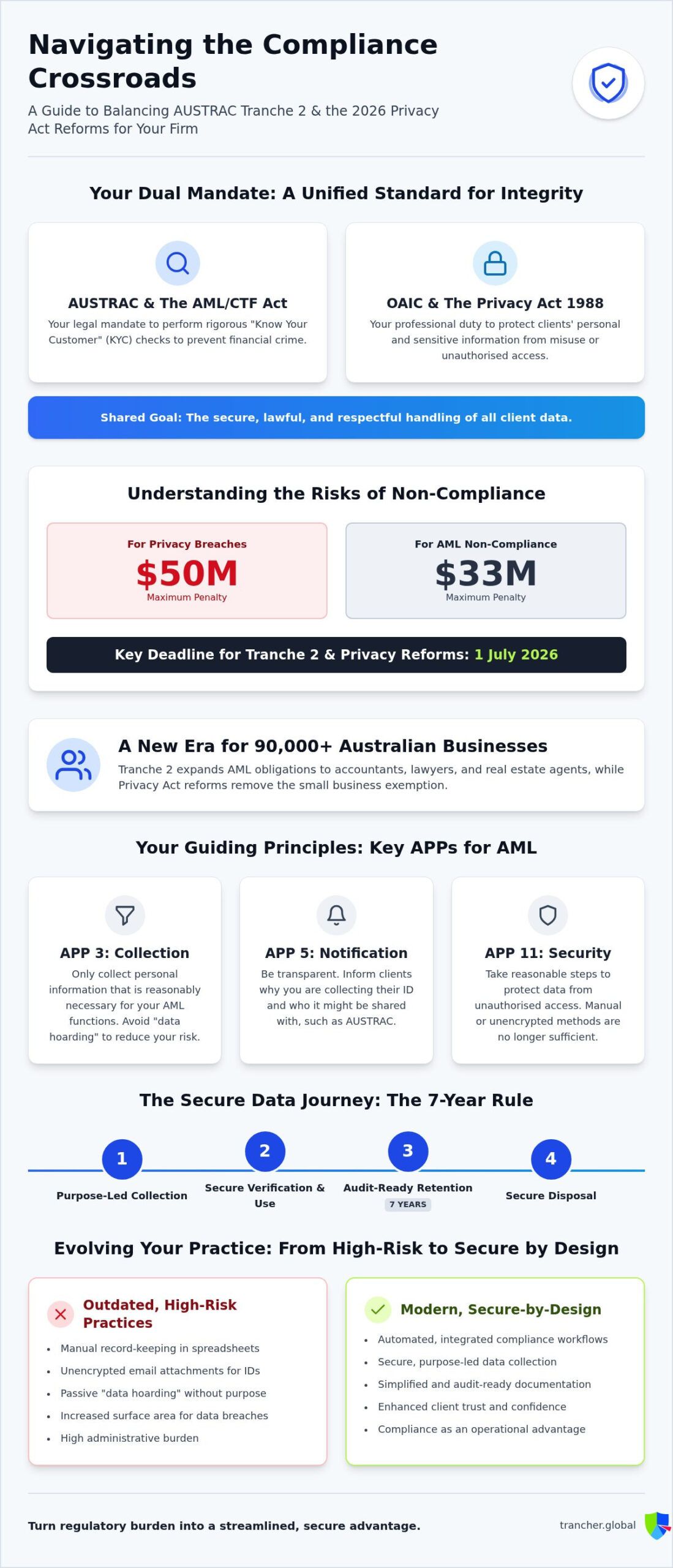
What if the very data you’re legally required to collect for AUSTRAC becomes the single biggest liability for your firm under the 2026 Privacy Act reforms? It’s a question weighing heavily on the minds of over 90,000 Australian business owners now facing Tranche 2 obligations. You’re likely feeling the pressure of balancing rigorous “Know Your Customer” checks against the strict requirement to protect sensitive ID documents. It’s understandable to feel overwhelmed when a single oversight could lead to penalties reaching $50 million for privacy breaches or $33 million for AML non-compliance.
We’re here to help you turn this regulatory burden into a streamlined, secure advantage. You’ll learn how to balance your privacy obligations for AML data collection with confidence, ensuring your firm meets the 1 July 2026 commencement date without doubling your administrative workload. This guide provides a practical framework for collecting only what’s necessary, clarifies the seven-year retention rules for KYC records, and introduces automated ways to keep your documentation audit-ready and secure. By the end, you’ll have a clear path to compliance that supports your firm’s growth rather than hindering it.
Key Takeaways
- Prepare for the 1 July 2026 deadline by aligning your AML program with the latest Privacy Act reforms to avoid significant non-compliance penalties.
- Master the balance between AUSTRAC’s rigorous KYC requirements and your privacy obligations for AML data collection through a “purpose-led” framework.
- Ensure your firm’s data retention policy is audit-ready by securely storing records for the mandatory seven-year period without increasing your administrative burden.
- Mitigate the risk of manual record-keeping by adopting automated workflows that protect sensitive identity documents and simplify the verification process.
- Transition from seeing compliance as a hurdle to an operational advantage that enhances client trust and improves your internal systems.
The Intersection of AML Compliance and Australian Privacy Laws
The relationship between the Anti-Money Laundering and Counter-Terrorism Financing (AML/CTF) Act and the Privacy Act 1988 is often viewed as a tug-of-war. On one side, you have a legal mandate to identify your clients; on the other, a duty to protect their personal information. These aren’t competing interests. Instead, they form a unified standard for professional integrity within the global anti-money laundering (AML) framework. Understanding your privacy obligations for AML data collection means recognising that AUSTRAC and the Office of the Australian Information Commissioner (OAIC) share a common goal: the secure, lawful handling of sensitive data.
Many firms believe they must choose between being a diligent reporter or a private one. This is a myth. Compliance with both regimes is not only possible but expected from day one of the Tranche 2 rollout. As a dual-regulated entity, your firm acts as a gatekeeper. You’re responsible for preventing financial crime while simultaneously upholding the highest standards of data stewardship. AUSTRAC monitors your compliance with the AML/CTF Act, while the OAIC ensures you respect the privacy rights of the individuals you verify. By treating these requirements as a single, integrated workflow, you eliminate administrative friction and build a more resilient practice.
The 2026 Regulatory Landscape for Australian SMEs
The 1 July 2026 Tranche 2 deadline marks a seismic shift for accountants, lawyers, and real estate agents. For the first time, approximately 90,000 Australian businesses will enter the regulated space. This transition coincides with sweeping 2024 Privacy Act reforms that likely remove the “small business exemption.” Whether your turnover is $200,000 or $20 million, you’re now an active steward of data. You aren’t just storing files; you’re managing a risk profile that requires constant oversight and precision. Passive data storage is no longer enough. You must adopt a proactive approach to how you collect, use, and eventually dispose of client identity documents.
Key Australian Privacy Principles (APPs) for AML
Your privacy obligations for AML data collection are grounded in three critical principles that dictate how you interact with client information. Focusing on these ensures your Know Your Customer (KYC) process is both legal and respectful.
- APP 3 (Collection): You must only collect personal information that’s reasonably necessary for your AML functions. This prevents “data hoarding” and reduces your potential breach surface area.
- APP 5 (Notification): You’re required to inform clients why you’re collecting their ID and who you might share it with, such as AUSTRAC. Transparency builds trust and simplifies the onboarding experience.
- APP 11 (Security): This is the heart of your compliance program. You must take reasonable steps to protect the data from unauthorised access or disclosure. In a digital-first environment, manual spreadsheets or unencrypted email attachments no longer meet this professional standard.
Understanding the Scope of AML Data Collection under Tranche 2
Collecting client data for compliance isn’t a one-size-fits-all task. It requires a precise understanding of what the law demands and what privacy standards protect. Under the AML/CTF Act, you’re required to verify the identity of your clients before providing a “designated service.” This process involves gathering personal information like full names, dates of birth, and residential addresses. However, your privacy obligations for AML data collection become more complex when you handle “sensitive information.” While a driver’s licence is personal information, biometric data or details about a client’s political affiliations, often checked during PEP screening, are sensitive and require higher levels of protection.
Government identifiers, such as passport numbers, Medicare details, or Tax File Numbers (TFNs), are particularly high-risk. These aren’t just data points; they’re keys to an individual’s identity. The OAIC guidance on privacy for AML reporting emphasises that you shouldn’t use or disclose these identifiers unless it’s necessary to fulfill your legal duties. This is especially true when dealing with complex trusts. You’re tasked with identifying the “Beneficial Owners,” the actual humans who ultimately own or control the entity. This means looking through layers of corporate structures to find the individual, which naturally increases the volume of data you must manage securely.
KYC vs. CDD: What Data is Actually Required?
Know Your Customer (KYC) is the initial step of identifying your client, usually through primary documents like a passport or secondary documents like a utility bill. Customer Due Diligence (CDD) is the broader process of understanding the client’s risk profile. If a client is flagged as high-risk, you must perform Enhanced Due Diligence (EDD), which might involve collecting evidence of their source of wealth or funds. For a deeper dive into these distinctions, see our CDD and KYC Requirements Australia: The 2026 Accountant’s Guide. Using a structured platform can help you automate these verification workflows to ensure you’re only gathering what is legally required.
The Risk of Over-Collection
It’s tempting to collect every document a client offers “just in case,” but this is a significant privacy liability. The principle of data minimisation dictates that you should only collect information relevant to the specific “designated service” being provided. If you can’t justify why you have a specific document during an OAIC audit or following a data breach, your firm could face penalties of up to $50 million. Every piece of data you hold is a potential point of failure. Understanding your privacy obligations for AML data collection ensures you can explain to your clients exactly why their data is needed, framing it as a necessary step for their own security and the integrity of the Australian financial system.
Managing the Conflict: Collection Necessity vs. Data Minimisation
Australian SMEs often feel caught between the competing demands of two powerful regulators. AUSTRAC mandates that you collect enough information to truly know your client, while the OAIC insists you don’t collect a single byte more than necessary. Managing your privacy obligations for AML data collection requires a shift from a “just in case” mindset to a “purpose-led” framework. This approach ensures that every document you request is directly linked to the designated service you’re providing. By anchoring your collection process in legal necessity, you protect your firm from the $50 million penalties associated with serious privacy breaches while remaining fully compliant with AML laws.
One of the most effective ways to bridge this gap is by implementing an AML-specific privacy policy. A generic policy rarely addresses the unique requirements of the AML/CTF Act, such as the mandatory seven-year retention period or the collection of sensitive identification documents. Your policy should clearly state that while you respect data minimisation, you’re legally bound to verify identities to protect the integrity of the Australian financial system. This clarity doesn’t just satisfy the regulator; it provides your staff with a script to handle difficult client conversations with confidence and professionalism.
The “Need to Know” Framework for SMEs
To stay safe, your firm must map every AUSTRAC requirement to a specific permission under the Privacy Act. When you move from standard verification to Enhanced Due Diligence (EDD), the volume of data you collect naturally increases. It’s vital to document your decision-making process during this transition. If you’re asking for source-of-wealth evidence, record the specific risk trigger that made this request necessary. Data minimisation is the practice of collecting only the minimum amount of personal information necessary to satisfy the specific legal requirements of the AML/CTF Act. By maintaining this disciplined focus, you reduce your firm’s data breach surface area significantly.
Transparency as a Trust Builder
Client resistance often stems from a lack of understanding. When a client asks, “Why do you need my passport?” they’re expressing a valid concern about their own data security. Use APP 5 collection notices as an educational tool rather than a mere formality. Explain that these checks are a standard part of the Tranche 2 obligations facing approximately 90,000 Australian businesses from 1 July 2026. Transparency turns a perceived intrusion into a value-add service. It demonstrates that your firm is a sophisticated, secure partner that takes the protection of their identity as seriously as the quality of your professional advice.
Effective communication also involves being honest about the operational costs and risks. By automating these workflows, you can reassure clients that their sensitive documents aren’t sitting in an unencrypted email inbox or a physical filing cabinet. Instead, they’re being handled through a secure, purpose-built system designed to meet the highest standards of active data stewardship.
Best Practices for Secure KYC Data Retention and Disposal
Securing client data isn’t a one-off event; it’s a seven-year commitment. Under the AML/CTF Act, your firm is legally required to retain all records relating to customer identification and designated services for a minimum of seven years after the relationship ends. While this ensures you’re ready for an AUSTRAC inspection, it also creates a significant long-term privacy risk. Managing your privacy obligations for AML data collection means ensuring that this data remains as secure in year six as it was on the day of collection. Relying on physical filing cabinets or unencrypted email attachments is no longer a viable strategy. These manual methods are highly susceptible to unauthorised access, which can trigger the Notifiable Data Breaches (NDB) scheme.
The NDB scheme requires you to notify both the OAIC and any affected individuals within 72 hours if a data breach is likely to result in serious harm. Given that KYC documents often include passports and driver’s licences, the potential for harm is exceptionally high. A data breach of AML data is a reportable offence to both the OAIC and AUSTRAC. To mitigate this, your firm should implement a strict “Secure Disposal” policy. Once the seven-year statutory period expires, you have a secondary privacy obligation to destroy or de-identify the data. Keeping sensitive ID documents “just in case” after the legal requirement has passed is a direct violation of the Australian Privacy Principles.
Audit-Ready Record Keeping in 2026
As we approach the 1 July 2026 deadline, the standard for what constitutes a “defensible” record is rising. Spreadsheets are no longer considered “defensible” by AUSTRAC because they lack the robust audit trails and version controls required to prove continuous compliance. Your records must be structured in a way that allows for quick regulatory review without compromising individual privacy. For a practical look at how to organise your firm, see our guide on Audit-Ready Compliance Records. Moving toward a digital, centralised system ensures that you can produce the necessary documentation for an audit instantly, demonstrating that your privacy obligations for AML data collection are being handled with professional precision.
Data Security: Beyond the Firewall
Protecting sensitive information requires a multi-layered defence. Encryption is the first line of that defence, and it must be applied both “at rest” when the data is stored and “in transit” when the data is being sent or received. Implementing multi-factor authentication (MFA) is also essential for any staff member accessing client identification files. MFA acts as a critical barrier against credential theft, ensuring that only authorised personnel can view sensitive ID documents. To simplify this complex security landscape, you can automate your record-keeping workflows with a platform designed specifically for the Australian regulatory environment. This not only secures the data but also removes the friction of manual filing, giving you more time to focus on your clients.
How Trancher Simplifies Privacy-Compliant AML Management
Meeting your privacy obligations for AML data collection shouldn’t feel like a high-wire act. While manual record-keeping creates a persistent risk of human error, Trancher provides a purpose-built vault designed specifically for the Australian regulatory landscape. Our platform acts as a secure bridge between AUSTRAC’s identification requirements and the OAIC’s data protection standards. By automating the most sensitive parts of the Know Your Customer (KYC) process, we remove the friction that often leads to administrative oversights and potential data breaches. We’ve designed our system to give you total confidence that your client files are both audit-ready and privacy-compliant from the moment of onboarding.
We understand that for many SMEs, the 1 July 2026 deadline feels like a significant hurdle. That’s why we offer a 30-day compliance-ready guarantee. Our platform doesn’t just store data; it manages the entire lifecycle of your compliance programme. This shift from manual to automated stewardship allows you to focus on your core professional services while we handle the technical complexities of encryption and secure storage. More importantly, Trancher helps you turn these regulatory duties into a billable, profitable service. By streamlining the verification process, you can accurately track the time and resources spent on compliance, ensuring your firm remains financially healthy while upholding the highest standards of integrity.
Automated Stewardship: The Trancher Advantage
The Trancher platform replaces risky manual habits with disciplined, automated workflows. Instead of asking clients to send sensitive identity documents via unencrypted email, you can provide them with a secure client portal for direct uploads. This immediately reduces your firm’s data breach surface area. Our built-in retention tracking also solves the “disposal dilemma” mentioned earlier; the system monitors the mandatory seven-year period and alerts you when records are ready for secure deletion. You also gain access to detailed ROI reporting, allowing you to demonstrate the value of your compliance activities to both your partners and your clients.
Ready for July 2026: Your Next Steps
The most successful transitions to Tranche 2 will be those that start early. Waiting until the 1 July 2026 commencement date to address your privacy obligations for AML data collection increases the risk of operational bottlenecks. We recommend starting your project plan now to ensure your staff are trained and your systems are integrated well in advance. To support your firm’s journey, we offer a complimentary 3-month trial, giving you ample time to experience how automation simplifies your workload. Our local Australian support team is ready to guide you through every step of the setup process.
Start your conversation with Trancher today to secure your firm’s future and transform your compliance obligations into a strategic advantage.
Securing Your Firm for the 2026 Regulatory Shift
The transition to Tranche 2 on 1 July 2026 represents a significant evolution in how professional service firms manage client information. By moving from passive storage to active data stewardship, you ensure your practice remains resilient in the face of stricter privacy reforms. Balancing your privacy obligations for AML data collection doesn’t need to be a source of stress; it’s an opportunity to refine your internal systems and enhance client trust through transparency and secure automation.
Trancher is specialised for Australian SMEs, providing the local support and expert onboarding you need to stay ahead of changing landscapes. We guarantee you’ll be AML/CTF compliance-ready within 30 days, allowing you to focus on growth while we handle the technical complexities of data retention and security. Secure your firm’s future with a complimentary 3-month Trancher trial. You’ve built a successful practice, and we’re here to help you protect it with steady guidance and reliable, automated solutions.
Frequently Asked Questions
Do I need to comply with the Privacy Act if I am a small business under the $3 million threshold?
Yes, you likely do. While a $3 million turnover exemption previously existed, the 2024 reforms and the specific nature of AML reporting mean most professional service firms must now comply. As a Tranche 2 entity, you’re handling sensitive identity documents, which places you under the OAIC’s oversight regardless of your turnover. Preparing for these privacy obligations for AML data collection now ensures your firm isn’t exposed to the significant penalties associated with serious privacy breaches.
How long am I required to keep AML and KYC records in Australia?
You must retain all records related to customer identification and designated services for a minimum of seven years after the client relationship ends. This is a mandatory requirement under the AML/CTF Act. It’s vital to have a system that tracks these dates automatically. Once this seven-year period concludes, your privacy obligations shift; you must securely dispose of or de-identify the data to remain compliant with Australian Privacy Principles and avoid unnecessary data liability.
Can I store client KYC documents on my local office server or Google Drive?
While technically possible, storing sensitive ID documents on general-purpose servers or basic cloud drives carries significant risk. These platforms often lack the specific audit trails and encryption levels required for “defensible” record-keeping. To meet your privacy obligations for AML data collection, you should use a purpose-built vault. This ensures that documents are encrypted at rest and in transit, and that access is strictly controlled via multi-factor authentication, reducing the likelihood of a reportable data breach.
What happens if there is a data breach of the AML data I have collected?
If a breach is likely to result in serious harm to your clients, you must notify the OAIC and the affected individuals within 72 hours. Because AML data includes high-value identifiers like passports, the “serious harm” threshold is easily met. Additionally, a breach of this nature is a reportable offence to AUSTRAC. Taking immediate steps to mitigate harm is required, and failing to notify the authorities can result in corporate penalties of up to $50 million.
Do I need a separate privacy policy specifically for AML data collection?
It is highly advisable to have an AML-specific privacy policy or a dedicated section within your existing policy. Standard policies often fail to address the mandatory seven-year retention period or the collection of sensitive biometric and identity data required by AUSTRAC. A tailored policy provides transparency for your clients and a clear operational framework for your staff. It demonstrates that your firm takes its dual role as a financial gatekeeper and a data steward seriously.
Can I use a third-party software to verify client identity under Australian law?
Yes, you can use third-party software, provided the platform aligns with the AUSTRAC “safe harbour” provisions or your firm’s own risk-based identity verification procedures. Using a specialised system like Trancher ensures that the verification process is consistent, automated, and audit-ready. This approach reduces the administrative burden on your team while providing a secure environment that satisfies both AML regulations and the strict privacy obligations for AML data collection expected by the OAIC.
Is an emailed copy of a passport considered secure for AML compliance?
No, sending sensitive identification documents via standard email is not considered a secure professional practice. Email is inherently vulnerable to interception, and storing these documents in your inbox creates a massive, unmanaged data breach surface area. Instead, you should use a secure client portal for all document uploads. This ensures that the data is encrypted from the moment it leaves the client’s device, fulfilling your duty to protect sensitive personal information from unauthorised access.
What are the penalties for failing to protect AML data under the Privacy Act?
The penalties for serious or repeated interferences with privacy are substantial. For a body corporate, fines can reach the greater of $50 million, three times the value of the benefit obtained, or 30% of adjusted turnover. Individuals, including business owners, can face personal liability with fines up to $2.5 million. These figures highlight why active data stewardship is no longer optional. Implementing a structured compliance system is the most effective way to safeguard your firm’s financial health.